
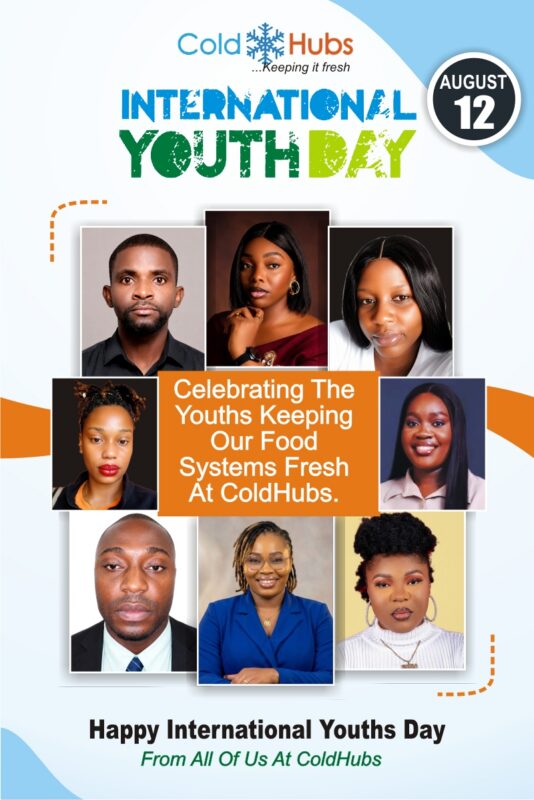
International Youth Day 2026 | Cover Story
How a workforce made up of 88% young people at ColdHubs is helping reshape the infrastructure behind Africa’s food systems.
Before the first trader arrives at the market, the cold room is already working.
The solar panels captures the sun. Temperatures are monitored. Produce is moved, stored and monitored. Customers are attended to. Payments are recorded. Refrigeration systems are maintained. Trucks move fresh food from one point to another.
Behind all of this, is a workforce that is rarely seen by the consumer.
And at ColdHubs, 88% of that workforce is below the age of 35.
That number is more than a demographic statistic.
It is a glimpse into what Africa’s next generation is already doing: building the infrastructure that keeps food moving and fresh.
The Number Behind the Story
Africa is often described as a continent of young people.
But numbers about youth can easily become abstract with millions of them in the labour market, millions looking for jobs, millions seeking opportunities.
The more interesting question is what young people are actually doing with those opportunities when they find them.
At ColdHubs, these young people are operating cold-storage facilities, working with refrigeration and solar technology, managing logistics, serving customers, analysing information, supporting business operations and helping expand access to cold-chain infrastructure.
Eight out of every ten members of the ColdHubs workforce are under 35.
That means the people helping solve one of the food system’s most persistent challenge are young.
They are not waiting for the future.
They are working on it.
A Cold Room Is More Than a Cold Room
Cold storage may look like a technical solution to a technical problem.
But look closer.
A cold room sits at the intersection of agriculture, energy, logistics, technology and commerce.
Someone has to keep the refrigeration system running.
Someone has to maintain the solar infrastructure.
Someone has to receive and organise produce.
Someone has to manage customers and payments.
Someone has to monitor operations and collect data.
Someone has to identify new markets and find ways to make the system work better.
The technology may preserve the food. But People make the system function.
This is why the cold chain is also a story about skills, employment and opportunity.
For farmers and traders, spoilage can mean lost income. For consumers, it can mean reduced availability and higher prices. For the food system itself, it means resources used to produce food that never reaches its full economic value.
The cold chain changes that equation.
By providing temperature-controlled storage and transportation, it gives perishable food something it normally does not have:
more time.
And time, in a food system, has economic value.
Where Youth Meets Opportunity
International Youth Day 2026 carries a simple but powerful theme:
Different Contexts, Common Aspirations.
A young refrigeration technician and a young communications professional may work in completely different environments.
A young logistics officer may have little in common professionally with a young cold-room operator.
A young person managing customers in a busy market may have a very different daily experience from someone working behind a laptop.
Their contexts differ.
Their skills differ.
Their paths differ.
But their aspirations can be remarkably similar:
To learn.
To earn.
To grow.
To contribute.
To build a future.
ColdHubs offers one example of what happens when those aspirations meet a real economic problem.
From Jobs to Careers
There is a difference between giving someone a job and giving them a pathway.
A job provides income.
A career builds capability.
The cold-chain sector has the potential to provide both.
Young people entering the industry can encounter disciplines that rarely exist in isolation: refrigeration, renewable energy, agriculture, logistics, technology, customer service, data, finance and business development.
A person may begin by learning how to operate a system and eventually take on greater technical, managerial or commercial responsibility.
That progression matters.
Because Africa does not only need more jobs.
It needs more people with the skills to build, operate and expand the systems of tomorrow.
The Young Workforce Behind the Cold Chain
The 88% figure tells an important story, but it does not tell the whole story.
Behind that number are individuals.
People checking temperatures before the market gets busy.
People responding when equipment needs attention.
People helping a trader understand how cold storage can protect produce.
People coordinating movement across the supply chain.
People managing finances, communications, customers and operations.
Different responsibilities.
Different ambitions.
One shared system.
And that system is helping address a challenge that extends far beyond any single company which is how to preserve more of what Africa already produces.
Africa’s Next Cold-Chain Workforce
The cold-chain industry of the future will not be built by refrigeration engineers alone.
It will need solar technicians.
Logistics managers.
Data analysts.
Software developers.
Sales professionals.
Finance specialists.
Entrepreneurs.
Communications professionals.
Operations managers.
And skilled people capable of connecting all these disciplines.
That is what makes the cold chain particularly relevant to Africa’s youth.
It is not simply an agricultural sector.
It is a meeting point for several of the industries expected to shape Africa’s economic future.
Agriculture. Energy. Technology. Logistics. Infrastructure. Climate adaptation.
For young people, that creates more than employment opportunities.
It creates opportunities to build expertise.
Young People Are Not Waiting for Tomorrow
For decades, young Africans have often been described as “the leaders of tomorrow.”
But tomorrow is an increasingly inadequate destination.
Because today, a young person is already maintaining the equipment that keeps food cold.
Today, another is coordinating the movement of fresh produce.
Today, another is using technology to improve operations.
Today, another is helping a business reach a new market.
Today, another is building a career in a sector that did not necessarily exist as a career path for the previous generation.
At ColdHubs, 88% of the workforce is already part of that story.
They are not simply preparing to inherit Africa’s food systems.
They are helping build them.
The Bigger Question
ColdHubs is one company.
Its experience cannot solve Africa’s youth employment challenge, and one statistic cannot tell the full story of a continent.
But the 88% figure raises a bigger question:
What could happen if more African businesses deliberately created pathways for young people into the industries that will define the continent’s future?
Not only agriculture.
But energy.
Manufacturing.
Technology.
Logistics.
Healthcare.
Infrastructure.
Climate resilience.
The answer will not come from one organisation.
It will come from millions of entry points—a first job, a technical skill, a new responsibility, an apprenticeship, a business idea, a chance to solve a difficult problem.
Sometimes, that first opportunity becomes a career.
Sometimes, the career becomes a business.
And sometimes, the employee becomes the employer.
Different Contexts. Common Aspirations.
The story of Africa’s youth is often told through enormous numbers.
But behind every number is a person making a choice about what to learn, where to work and what kind of future to build.
One chooses refrigeration.
Another chooses renewable energy.
Another chooses logistics.
Another chooses technology.
Another chooses agriculture.
Another manages a cold-storage facility in a busy market.
Different contexts.
Different professions.
Different starting points.
But common aspirations.
To create.
To contribute.
To grow.
To make an impact.
The 88% of young people working at ColdHubs are one example of a much larger possibility: that Africa’s food-system transformation will not simply be something young people watch unfold.
They will be among the people building it.
And perhaps that is what International Youth Day should remind us.
Youth is not merely a promise of what comes next.
It is a workforce, a source of ideas and a force already shaping what comes next.
The future of Africa’s food system is being built today.
And it is being built by young people.
Explore the work behind the cold chain. Follow ColdHubs as we continue building the infrastructure that keeps food fresh, protects livelihoods and connects Africa’s food systems.