
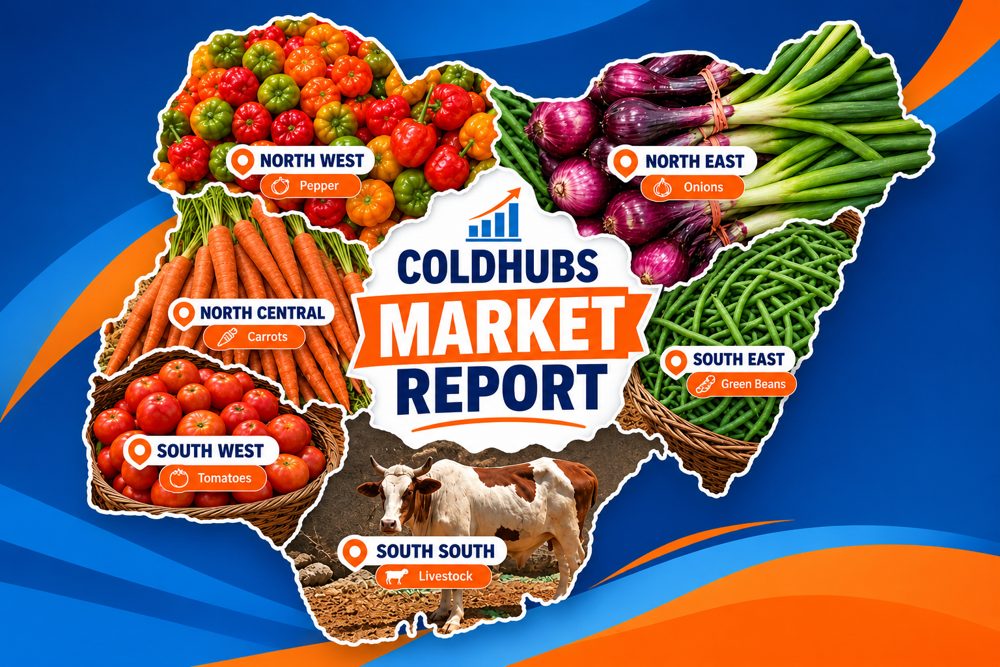

19 – 24 OCTOBER 2026
Weekly Market Report

Introduction
Market Weekly is ColdHubs’ weekly snapshot of fresh produce markets, bringing you key updates on prices, supply, demand, market conditions and emerging trends from markets across our network.
Each edition combines on-the-ground market intelligence from ColdHubs Hub Managers and Operators with relevant weather insights to provide a practical outlook on what to expect in the week ahead.
Market Weekly — Know the Market. Plan Better.
Prices from North-Central.
Fresh produce prices are generally increasing this week, with Tomatoes, Green Beans and Spring Onions all trading higher and Carrots largely stable. Supply decreased for all produce except Pepper, which remains in high supply. Comparisons below are made against our 12 – 17 October report.
Produce of the Week: Pepper
Pepper remains in high supply and is the only produce whose supply did not decrease. Prices are mixed against last week: up in the North-West (₦15,000–18,000 to ₦23,000–25,000) and South-West (₦30,000–40,000 to ₦35,000–50,000), flat in North-Central at ₦20,000–25,000, and slightly lower in the South-East (₦45,000–50,000) and South-South (₦50,000–55,000). There is a chance that Pepper prices will increase.
Low Supply Fresh Produce: Tomatoes and Spring Onions
Tomatoes and Spring Onions are in low supply and prices are up. Tomatoes rose in North-Central (₦10,000–15,000 to ₦30,000–35,000), South-East (₦45,000–50,000 to ₦50,000–60,000) and South-South (₦45,000–50,000 to ₦55,000–65,000), while North-West eased to ₦25,000–50,000. Spring Onions rose or held firm in every zone, with North-West up from ₦10,000–15,000 to ₦20,000–30,000 and South-East from ₦30,000–32,000 to ₦35,000–40,000.
Price Direction: Carrots
Carrots are stable overall. North-Central (₦60,000–70,000) and South-East (₦70,000–75,000) held, and North-West is little changed at ₦35,000–58,000. South-South eased from ₦72,000–75,000 to ₦60,000–65,000, while South-West rose from ₦45,000–60,000 to ₦60,000–65,000.
Rising Prices: Green Beans
Green Beans are up in most zones. South-West jumped from ₦40,000–50,000 to ₦70,000–72,000 (about 58%), North-Central rose from ₦20,000–25,000 to ₦30,000–35,000 and North-West from ₦35,000 to ₦35,000–45,000. South-East held at ₦45,000–50,000, while South-South edged up to ₦50,000–52,000.
Price Direction vs 12 – 17 October
Tomatoes: ↑ Increasing. Green Beans: ↑ Increasing. Spring Onions: ↑ Increasing. Pepper: → Mixed, with a chance of increasing. Carrots: → Stable. Overall, prices are generally increasing.
TAKE HOME
Prices are generally rising while supply of most produce is falling, so stock kept in good condition is worth more. Pepper is the exception: supply is high and prices may still rise, so traders who store Pepper properly can hold it for better prices instead of selling in a rush. Move Green Beans quickly, as they carry the highest spoilage risk this week.
High Spoilage Risk Fresh Produce
Green Beans are the fresh produce at highest risk of spoilage this week. With prices rising, every spoiled pod is lost income, so locate the nearest ColdHub to keep them cool and sell quickly.
19 – 24 October 2026 · Six Geopolitical Zones in Nigeria
| S/N | Produce | N/Central | N/East | N/West | S/East | S/South | S/West |
|---|---|---|---|---|---|---|---|
| 1 | Tomatoes | ₦30,000-35,000 | – | ₦25,000-50,000 | ₦50,000-60,000 | ₦55,000-65,000 | ₦55,000-60,000 |
| 2 | Pepper | ₦20,000-25,000 | – | ₦23,000-25,000 | ₦45,000-50,000 | ₦50,000-55,000 | ₦35,000-50,000 |
| 3 | Carrots | ₦60,000-70,000 | – | ₦35,000-58,000 | ₦70,000-75,000 | ₦60,000-65,000 | ₦60,000-65,000 |
| 4 | Green Beans | ₦30,000-35,000 | – | ₦35,000-45,000 | ₦45,000-50,000 | ₦50,000-52,000 | ₦70,000-72,000 |
| 5 | Spring Onions | ₦30,000-32,000 | – | ₦20,000-30,000 | ₦35,000-40,000 | ₦35,000-40,000 | ₦25,000-35,000 |
Note: “-” indicates no price data recorded for that zone at this time. Quantities: Tomatoes 50kg, Pepper 25kg, Carrots 70kg, Green Beans 25kg, Spring Onions 70kg.
PEPPER
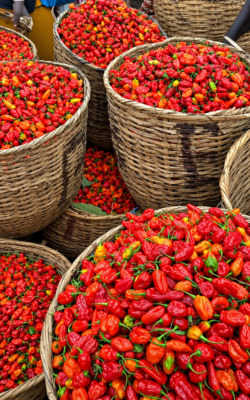
Pepper remains the produce of the week as the only produce in high supply. While supply of every other produce decreased this week, Pepper supply held up. Prices run from ₦20,000–25,000 in North-Central to ₦50,000–55,000 in the South-South, and there is a chance they will increase.
Pepper carries a Moderate spoilage risk. With prices likely to rise, traders who store Pepper well can hold stock for better prices instead of selling in a rush. That is where ColdHubs cold storage helps traders protect their margins.
Our market outlook for the week.
Tomatoes: ↑ Increasing Price · Low Supply
Pepper: → Mixed Price, Chance of Increase · High Supply
Spring Onions: ↑ Increasing Price · Low Supply
Green Beans: ↑ Increasing Price · High Spoilage Risk
Carrots: → Stable Price
Livestock (Cow): → Stable Price
HIGH-RISK PRODUCE THIS WEEK
Green Beans — HIGH RISK
Delicate pods, warm temperatures and delays in selling can quickly reduce quality.
When prices are rising, protect the produce you have.
Supply of most produce fell this week while prices climbed, so every crate that spoils is lost income. Pepper is the exception, with high supply and a chance of rising prices.
With cold storage, you can:
- Keep Green Beans fresh and sellable for longer.
- Hold Pepper until prices rise instead of selling in a rush.
- Cut losses on Tomatoes and Spring Onions while supply is low.
The ColdHubs Market Report and Forecast brings together market observations, weather intelligence and cold-chain insights to help stakeholders better understand the fresh produce ecosystem.
Are you a farmer, trader, buyer or into food business? What are you seeing in your market this week?
Share your market observations with us.
ColdHubs Limited
KEEPING IT FRESH