
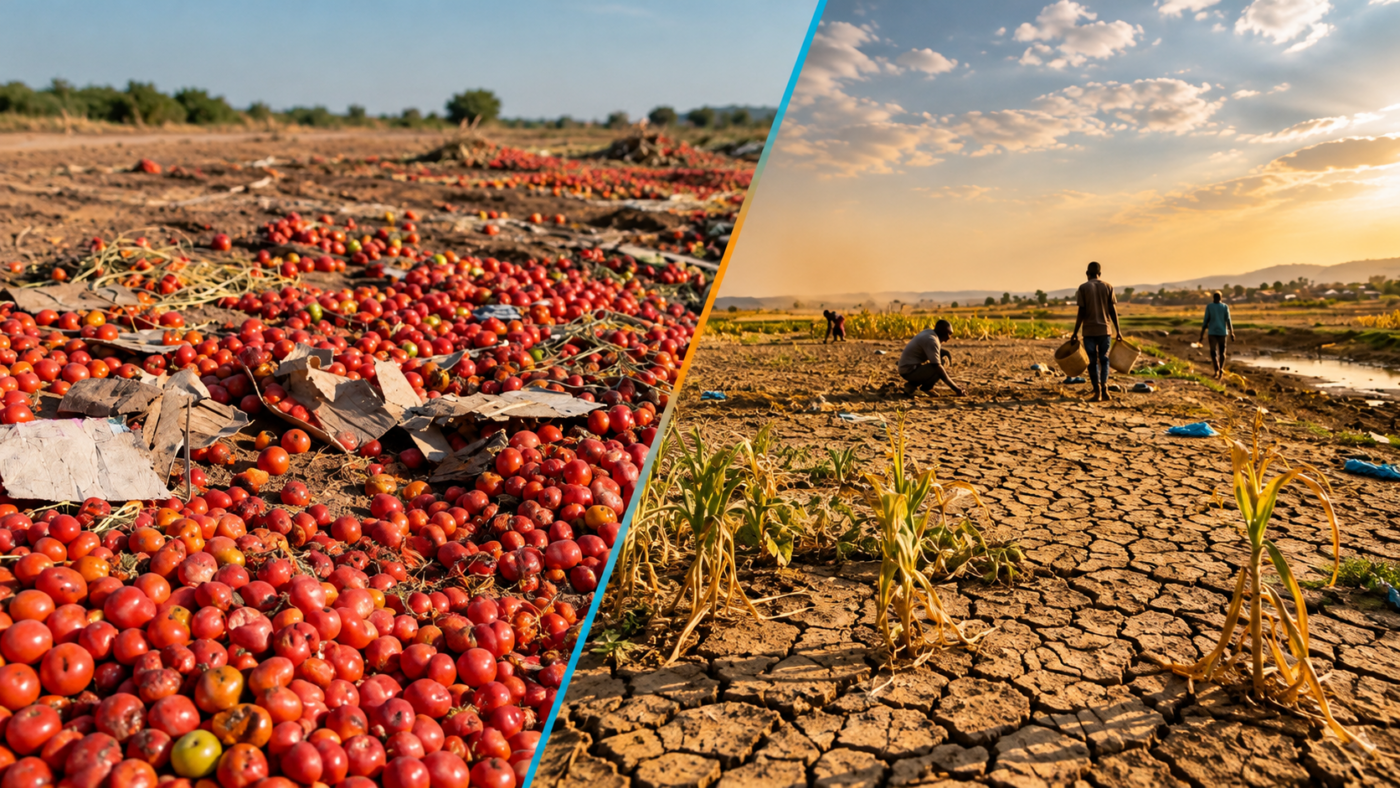

El Niño is changing weather patterns across the world. For businesses handling perishable food, the consequences do not end with the harvest. They continue wherever food is exposed to heat without adequate cooling.
El Niño does not spoil a tomato. But the weather conditions associated with it can make an already vulnerable food supply chain more difficult to manage.
The phenomenon, characterised by unusually warm sea-surface temperatures in the central and eastern tropical Pacific, influences temperature and rainfall patterns across different parts of the world. The World Meteorological Organization (WMO), in its 8 October 2026 update, reported that the current El Niño event is strengthening and is expected to peak around December 2026, with implications for global temperatures and regional rainfall patterns.
Its effects are not uniform. FEWS NET’s October 2026 assessment identifies risks of above-average temperatures and below-average rainfall across parts of Southern Africa, while the Greater Horn of Africa faces increased heavy-rainfall and flood risks. In West Africa, the effects are more localised, particularly across parts of the central and eastern Sahel, including northeastern Nigeria.
These differences matter. But whether the pressure comes from higher temperatures, prolonged dry conditions or extreme rainfall, one vulnerability deserves closer attention: the ability to preserve food after harvest.
Sources: WMO, October 2026 | FEWS NET, 2026–2027 El Niño Food Security Impacts.
How El Niño Increases the Risk of Food Spoilage
The connection between El Niño and post-harvest deterioration is not just simply that warmer weather which makes food spoil faster. It is how changing climate conditions intensify the temperature and logistical pressures already present in food supply chains.
For fresh fruits and vegetables, harvesting does not stop biological activity. Produce continues to respire, lose moisture and undergo enzymatic changes after it is separated from the plant.
As temperatures increase, these processes generally accelerate. Produce softens, loses moisture, ripens or deteriorates more quickly, reducing the time available for storage, transportation and sale.
The FAO’s technical guidance on post-harvest handling identifies temperature control as a critical factor in maintaining produce quality. Cooling slows respiration, ethylene production, enzymatic activity and water loss. It also slows the growth of microorganisms responsible for decay.
This explains why the time between harvesting and cooling is so important. Produce that remains exposed to high temperatures after harvest begins losing quality before it reaches the market or storage facility.
Source: FAO, Temperature and Relative Humidity Control.
The problem is equally serious for fish.
According to the FAO’s Code of Practice for Fish and Fishery Products, temperature is the single most important factor affecting the rate of fish deterioration and the multiplication of microorganisms. Fresh fish that requires chilling should be cooled as quickly as possible and maintained close to 0°C under appropriate conditions.
In practical terms, a delayed supply of ice, prolonged exposure during loading or transportation without adequate cooling can significantly shorten the period in which fish remains suitable for sale and consumption.
Source: FAO, Code of Practice for Fish and Fishery Products.
El Niño does not create these biological processes. It can intensify the environmental conditions under which they become harder to control.
The Damage Does Not End With Higher Temperatures
Temperature is only one part of the problem.
El Niño also alters rainfall patterns, and those changes can affect the movement and availability of food.
In drought-affected areas, reduced rainfall can constrain agricultural production, water availability and the livelihoods dependent on farming and livestock. In areas exposed to heavier rainfall, flooding can damage roads, disrupt transportation and delay the movement of harvested products.
For businesses handling perishables, these disruptions can create additional time between harvest, storage and delivery.
The current regional outlook illustrates why a single response cannot be applied everywhere. FEWS NET projects below-average rainfall and above-average temperatures across much of Southern Africa during the October 2026 to March 2027 rainy season. In parts of the Horn of Africa, above-average rainfall and flooding are significant concerns. Across West Africa, the impact is more concentrated in the Sahel, with moderate rainfall deficits reported in northeastern Nigeria and more favourable seasonal performance in parts of the Sudano-Guinean zone.
This regional variation is important for agricultural businesses and policymakers. Climate risk assessments and food-preservation strategies must be informed by local weather forecasts, commodity requirements and supply-chain conditions—not by assumptions that El Niño produces the same effects everywhere.
Source: FEWS NET, October 2026 Regional Assessment.
Cold-Chain Infrastructure: A Direct Response to Temperature-Related Spoilage
If elevated temperatures accelerate deterioration, controlling product temperature becomes one of the most immediate ways to reduce that risk.
This is where cold-chain infrastructure moves from being an operational convenience to a practical response to climate-related food losses.
For fresh produce, rapid cooling after harvest helps remove field heat and slow the biological processes responsible for quality deterioration. Appropriate cold storage then maintains suitable conditions until the product is ready for sale or distribution.
For fish, timely icing and chilled storage help slow microbial activity and maintain product quality. For businesses transporting temperature-sensitive goods, refrigerated vehicles help maintain required conditions during transit.
But these interventions must operate as a connected system.
Cooling produce at the point of collection is of limited value if it is subsequently exposed to high temperatures during transport. Storing fish properly does not protect it if there is a prolonged break in temperature control before delivery.
The objective is to reduce the time food spends exposed to unsuitable conditions—from the point of harvest or landing through storage, transportation and sale.
The FAO’s 2026 article, Cooling the Chain, Cutting the Waste, identifies the importance of pre-cooling, market-level cold storage, ice production and refrigerated transportation. It also points to decentralised solar energy as an option for supporting cooling infrastructure in areas where grid electricity is unreliable or unavailable.
For African agricultural markets, where energy reliability and operating costs influence access to refrigeration, solar-powered cold storage offers a practical approach to expanding cooling services. It can reduce dependence on grid electricity and diesel-powered alternatives, depending on system design and operating conditions.
The case for cold-chain investment is therefore not simply about extending shelf life. It is about reducing the amount of time perishable food spends exposed to the conditions that accelerate spoilage.
The Climate Cost of Failing to Cool Food
There is another reason this issue deserves urgent attention: food loss also carries an environmental cost.
When harvested food deteriorates before reaching consumers, the land, water, energy, labour and other resources used in its production are also lost.
The UNEP and FAO report Sustainable Food Cold Chains: Opportunities, Challenges and the Way Forward estimates that inadequate refrigeration contributes to the loss of 526 million tonnes of food annually, equivalent to approximately 12% of global food production.
The report also highlights a critical consideration: refrigeration must be expanded sustainably. Cooling equipment consumes energy, and refrigerant emissions can contribute to global warming. An effective climate response must therefore prioritise energy-efficient equipment, appropriate refrigerants and renewable energy where viable.
This is why the solution cannot simply be to install more refrigeration units. It must be to develop cold chains that preserve food while managing their own environmental footprint.
Source: UNEP and FAO, Sustainable Food Cold Chains.
Post-Harvest Protection Must Be Part of El Niño Preparedness
The strengthening El Niño event should prompt governments, agricultural organisations and food businesses to consider how vulnerable their post-harvest operations are to temperature and weather disruptions.
For farmers and produce aggregators, this means reducing the time between harvest and appropriate cooling, keeping produce shaded while awaiting collection and planning storage around expected harvest volumes.
For fish traders and businesses, it means ensuring that ice or suitable chilling facilities are available without delay.
For distributors and food businesses, it means accessing cold storage and transportation facilities to maintain appropriate temperatures, even when weather conditions disrupt normal operations.
For policymakers and investors, it means treating cold-chain infrastructure as part of the facilities required to protect agricultural production- not as an investment that can be postponed until after food losses have occurred.
Climate preparedness must account for what happens to food after it leaves the farm.
Protecting Food in a Warming World
At ColdHubs, our focus is on providing practical cold-chain solutions for businesses and communities handling perishable products.
Through solar-powered cold storage, ice services and refrigerated transportation, we support the storage and movement of temperature-sensitive food under appropriate conditions.
The challenge posed by El Niño reinforces the need for these services to be accessible, reliable and properly integrated into food supply chains. It also reinforces the importance of handling products correctly and maintaining temperature control throughout their journey.
El Niño cannot be switched off. But the exposure of harvested food to damaging temperatures can be managed.
The heat may be beyond our control. Leaving food unprotected from it should not be.
In a warming world, cold-chain infrastructure must become a more deliberate part of how Africa prepares its food systems for climate-related disruption.
Because protecting food after harvest is no longer just an agricultural concern. It is a climate resilience priority.
Explore Cold-Chain Solutions with ColdHubs
ColdHubs provides solar-powered cold storage, ice services and refrigerated transportation for businesses handling perishable products.
Visit www.coldhubs.com or email info@coldhubs.com to discuss your cold-chain requirements. Or chat on Whatsapp and Telegram: 09011695995
Message Coldhubs Limited on WhatsApp. https://wa.me/2349011695995
References
- World Meteorological Organization — Sea-Surface Temperatures Reflect Strengthening El Niño, 8 October 2026
- FEWS NET — 2026–2027 El Niño Food Security Impacts, 6 October 2026
- FAO — Temperature and Relative Humidity Control
- FAO — Code of Practice for Fish and Fishery Products
- FAO — Cooling the Chain, Cutting the Waste, 30 March 2026
- UNEP and FAO — Sustainable Food Cold Chains: Opportunities, Challenges and the Way Forward