
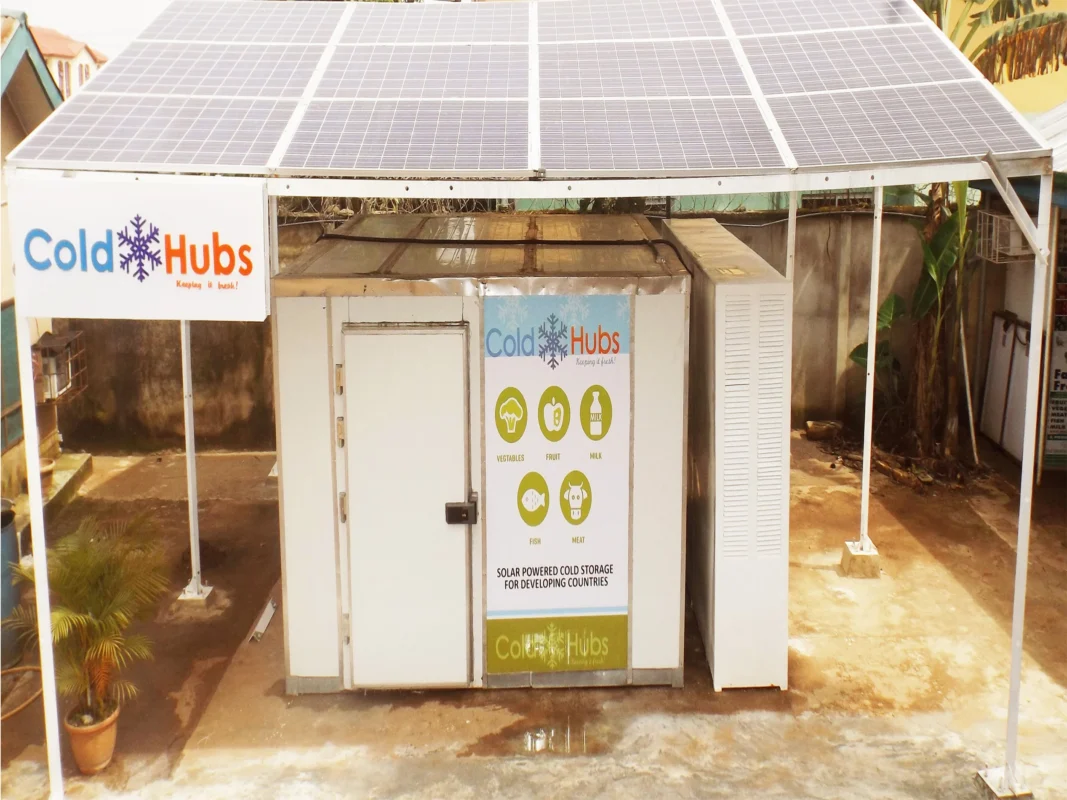
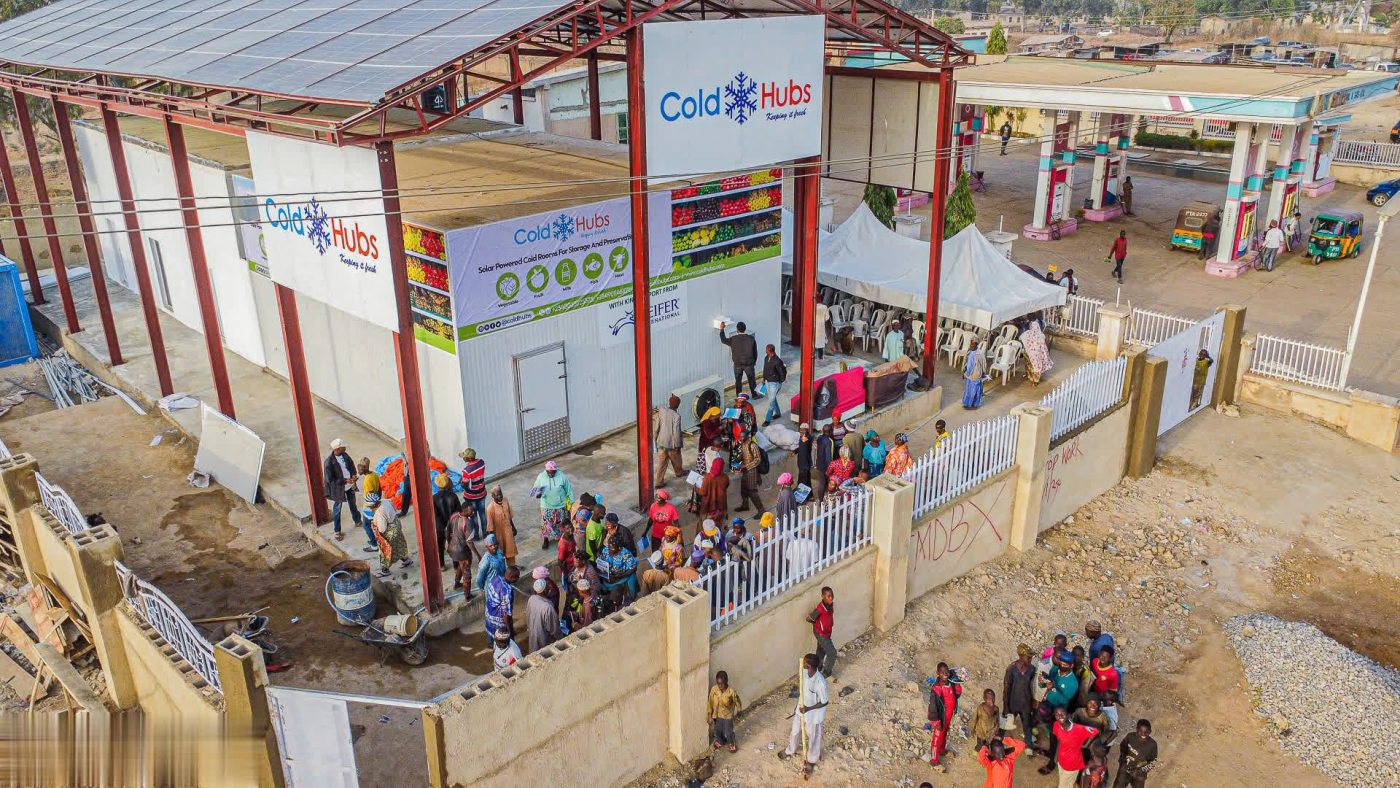
Picture of Coldhubs 2.0
In 2013, at Farin Gada Market in Jos, Plateau State, the problem was impossible to ignore.
Fresh cabbages were deteriorating in the market while farmers and traders had little choice but to sell quickly, accept lower prices or watch part of their harvest become waste.
The request from the farmers was simple: they needed somewhere to keep their produce fresh long enough to sell it.
A year later, the response was taking physical form.
The first experimental cold room was built in 2014 using scrap metal. It was far from the sophisticated clean-cooling infrastructure the company operates today, but it was designed to answer one fundamental question:
Could affordable refrigeration help smallholder farmers and traders keep fresh food alive for longer?
That early experiment became the beginning of a much bigger engineering journey.
More than a decade later, the story of ColdHubs is not simply about building more cold rooms. It is about continuously redesigning how cooling is generated, stored, delivered and accessed in markets where electricity can be unreliable, farmers operate on tight margins and every kilogram of spoiled food represents lost income.
ColdHubs 1.0: Proving That Solar Cooling Could Work
The first generation of ColdHubs established the basic model: use solar energy to power walk-in cold rooms that allow farmers, wholesalers and retailers to store perishable food close to where it is produced or sold.
Instead of requiring individual farmers to purchase expensive refrigeration equipment, ColdHubs developed a pay-as-you-store model.
Users could bring their produce, store it in reusable crates and pay according to the amount of space and period of storage they required.
But operating the first generation also produced something equally valuable: information.
Real markets became laboratories.
ColdHubs could observe how much food customers brought in, when they brought it, how quickly warm produce needed to be cooled, how customers used available space and how the energy system performed under real Nigerian conditions.
And those lessons exposed limitations.
ColdHubs 1.0 relied on batteries for electrical energy storage.
Batteries made it possible to continue providing cooling when solar energy was unavailable, but the company began looking for a system that could accommodate greater volumes of food while reducing dependence on conventional battery storage.
The next question became:
Instead of storing electricity and later using that electricity to create cold, could we store the cold itself?
ColdHubs 2.0: Storing Energy as Cold
That question led to ColdHubs 2.0.
The second-generation system incorporated phase-change materials and thermal energy storage, in contrast to the battery-based energy storage used in ColdHubs 1.0. ColdHubs began publicly developing the technology around 2020 and subsequently deployed ColdHubs 2.0 facilities in Nigerian markets.
The science behind it sounds complicated, but the principle is familiar.
Think about what happens when water becomes ice.
Energy is used to freeze it. Later, as the ice absorbs heat and melts, that stored cooling energy is released.
Phase-change thermal storage applies the same broad principle using materials selected to change phase at useful temperatures.
During periods when solar power is available, the refrigeration system can create and store cooling energy. That stored cold can then help maintain the required temperature when solar generation falls.
In simple terms, instead of asking a battery to hold all the energy as electricity, thermal storage allows part of that energy to be held in the form in which it is ultimately required:
cold.
This is not merely a ColdHubs experiment.
Cold thermal energy storage using phase-change materials has become an important field of refrigeration research. Studies have examined its potential to stabilise temperatures, improve refrigeration efficiency and reduce energy demand across cold stores, food transportation and other cold-chain applications.
For an off-grid or energy-constrained cold chain, that distinction matters.
The challenge is not only producing renewable electricity.
It is making sure cooling remains available when the food needs it.
Bigger Hubs Were Only Part of the Evolution
ColdHubs 2.0 also reflected another lesson from operating the first generation: demand could exceed the capacity of smaller facilities.
When ColdHubs announced development of the second generation in 2020, it said its existing 1.0 model could store approximately three tonnes of food daily and that the new design was intended to accommodate significantly larger volumes while reducing battery dependence.
But simply constructing bigger cold rooms could never solve the entire post-harvest problem.
Food does not remain inside a cold room forever.
Eventually, it has to move.
And that exposed another weak link.
A farmer could preserve tomatoes at the market, but if those tomatoes were later loaded into an unrefrigerated vehicle for a long journey under high ambient temperatures, part of the benefit of cold storage could be lost.
ColdHubs therefore had to begin thinking beyond the cold room.
From Cold Rooms to a Cold Chain
In 2022, ColdHubs expanded into refrigerated transportation, providing temperature-controlled logistics for fruits and vegetables and other temperature-sensitive products. The company later expanded its fleet and added tracking systems capable of monitoring vehicle and temperature conditions during transportation.
Reusable plastic crates became another part of the system.
That may look like a much simpler technology than solar panels or thermal storage, but post-harvest loss is not caused by temperature alone.
Produce can also be damaged through crushing, bruising, poor ventilation and inappropriate packaging.
A functioning cold chain therefore needs to protect food physically as well as thermally.
IcePoints expanded access to cooling for businesses and market users requiring ice, while larger cold-storage facilities increased the volumes that could be handled.
Then another layer emerged: digital access.
ColdConnect now allows customers to locate ColdHubs and IcePoints, book and pay for cold-storage services, request refrigerated transport and order or rent reusable crates.
Step by step, the original cold room was becoming something different.
A cold-chain network.
Innovation Is Not About Building the Most Complicated Machine
There is an important lesson in that evolution.
Innovation is sometimes described as the introduction of completely new technology.
But in infrastructure, the more useful form of innovation is often continuous improvement.
Build.
Deploy.
Observe.
Discover what fails or what customers still struggle with.
Redesign.
Deploy again.
The 2014 experimental cold room did not need to look like the ColdHubs of today.
Its job was to prove something.
ColdHubs 1.0 then had to demonstrate that decentralised solar-powered cold storage could operate close to the farmers and traders who needed it.
ColdHubs 2.0 had to ask how greater cooling capacity and thermal storage could improve the model.
Refrigerated trucks addressed what happened when food left the cold room.
Crates addressed handling.
IcePoints extended cooling into other market activities.
ColdConnect began connecting those physical services through a digital platform.
Each innovation addressed a different break in the same chain.
Why Thermal Storage Matters Beyond ColdHubs
This evolution is also part of a much bigger global conversation.
Demand for cooling is rising, particularly in regions experiencing population growth, urbanisation and higher temperatures.
At the same time, simply meeting that demand with conventional, energy-intensive refrigeration would create another problem.
The challenge is therefore to expand access to cooling while reducing the energy and environmental cost of providing it.
Recent research continues to identify phase-change materials and cold thermal energy storage as promising technologies for improving refrigeration efficiency and managing energy demand. Applications being investigated range from stationary cold stores to refrigerated transportation and food packaging.
For African food systems, this could be particularly significant.
Solar energy is abundant during the day.
Fresh food needs protection around the clock.
The engineering challenge is finding efficient ways of connecting those two realities.
Thermal storage is one of the technologies helping the industry do that.
The Next ColdHub Will Not Be the Last ColdHub
The most important part of ColdHubs’ technology story may therefore be that it is unfinished.
The cold room that works today should not automatically be the cold room built ten years from now.
Sensors are improving.
Artificial intelligence is creating new possibilities for forecasting refrigeration demand and equipment maintenance.
Thermal storage materials continue to advance.
Digital platforms can increasingly connect storage, transportation, inventory and markets.
Data from cold rooms can potentially help operators understand not only whether equipment is working, but when demand will rise, where additional capacity is needed and how food can move more efficiently through the supply chain.
The future cold chain will therefore be more than refrigerated infrastructure.
It will increasingly combine clean energy, thermal engineering, logistics, data and intelligent decision-making.
For ColdHubs, that future traces back to a much simpler beginning.
A market.
Spoiling cabbages.
Farmers asking for somewhere to keep their food.
And an experimental cold room made partly from scrap metal.
The technology has changed dramatically since then.
The problem has not.
Food that has already been grown should not be lost simply because the infrastructure required to preserve it is missing.
That has remained the engineering challenge from ColdHubs 1.0 to ColdHubs 2.0 and the wider cold-chain network being built today.
And every new generation of technology brings the industry closer to solving it.