

12 – 17 OCTOBER 2026
Weekly Market Report
Introduction
Market Weekly is ColdHubs’ weekly snapshot of fresh produce markets, bringing you key updates on prices, supply, demand, market conditions and emerging trends from markets across our network.
Each edition combines on-the-ground market intelligence from ColdHubs Hub Managers and Operators with relevant weather insights to provide a practical outlook on what to expect in the week ahead.
Market Weekly — Know the Market. Plan Better.
Prices from the biggest market in the North Cental ( Faringada Market)
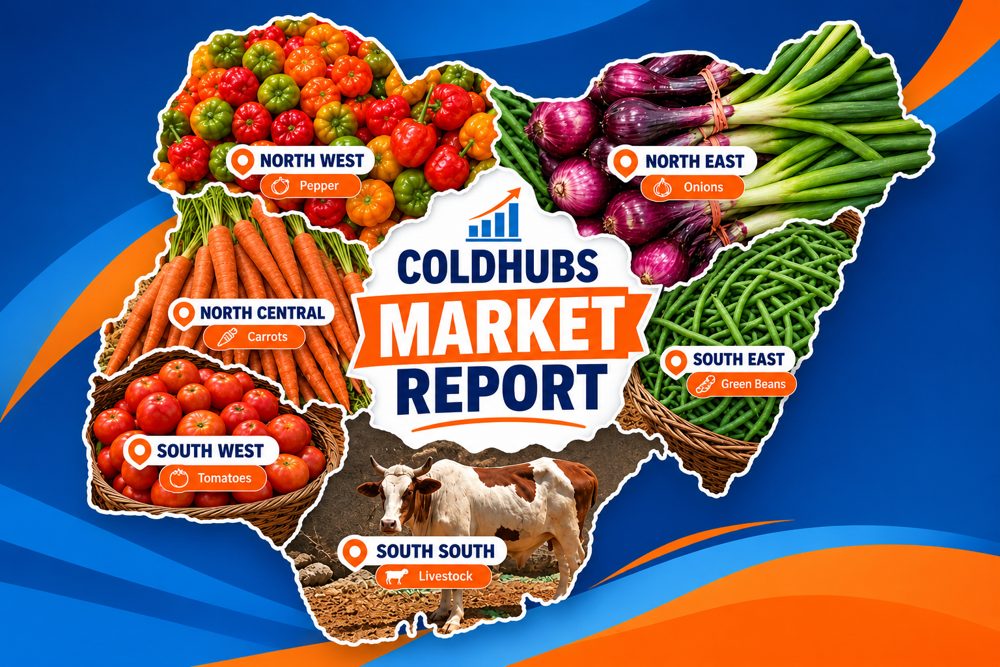
Fresh produce markets monitored by ColdHubs this week show Pepper prices falling sharply on high supply, Tomato prices rising on low supply, and mixed movement for Carrots, Green Beans and Spring Onions. Comparisons below are made against our 28 September – 3 October report.
Produce of the Week: Pepper
Pepper is in high supply and prices fell in every zone with data. South-West dropped from ₦120,000–140,000 to ₦30,000–40,000 (about 73%), North-West from ₦40,000 to ₦15,000–18,000 (about 59%), South-South from ₦80,000 to ₦55,000–60,000 (about 28%), South-East from ₦70,000 to ₦50,000–55,000 (about 25%) and North-Central from ₦26,000–30,000 to ₦20,000–25,000 (about 20%).
Low Supply Fresh Produce: Tomatoes and Spring Onions
Tomatoes are in low supply and prices rose in the North-West (₦20,000–35,000 to ₦44,000–48,000, about 67%), South-East and South-South (both from ₦40,000–45,000 to ₦45,000–50,000). South-West held at ₦50,000–60,000, while North-Central eased to ₦10,000–15,000. Spring Onions are also in low supply, with the North-West at ₦10,000–15,000 and the South-East up from ₦25,000 to ₦30,000–32,000.
Price Direction: Carrots
Carrots are decreasing overall, driven by the South. South-West fell from ₦100,000–110,000 to ₦45,000–60,000 (about 50%), while South-East and South-South eased to ₦70,000–75,000 and ₦72,000–75,000. In the North, North-Central rose to ₦60,000–70,000 and North-West to ₦45,000–50,000.
Mixed Movement: Green Beans
Green Beans moved in opposite directions. North-Central eased from ₦25,000–30,000 to ₦20,000–25,000 and North-West from ₦40,000–45,000 to ₦35,000, while South-East and South-South rose to ₦45,000–50,000 and South-West to ₦40,000–50,000.
Price Direction vs 28 September – 3 October
Tomatoes: ↑ Increasing. Pepper: ↓ Decreasing. Carrots: ↓ Decreasing (higher in the North, lower in the South). Green Beans: → Mixed (lower in the North, higher in the South). Spring Onions: → Mixed, slightly lower on average (down in four of five zones).
TAKE HOME
Pepper prices are falling because supply is high, so selling in a rush means accepting distress prices. Well-preserved Pepper can be held until prices recover, and with Tomatoes in low supply and prices rising, well-kept stock can be sold when and where the price is best.
High Spoilage Risk Fresh Produce
Green Beans are the fresh produce at highest risk of spoilage this week. As a delicate vegetable, it loses firmness and quality quickly in warm conditions when sales are delayed.
12 – 17 October 2026 · Six Geopolitical Zones in Nigeria
| S/N | Produce | N/Central | N/East | N/West | S/East | S/South | S/West |
|---|---|---|---|---|---|---|---|
| 1 | Tomatoes | ₦10,000-15,000 | – | ₦44,000-48,000 | ₦45,000-50,000 | ₦45,000-50,000 | ₦50,000-60,000 |
| 2 | Pepper | ₦20,000-25,000 | – | ₦15,000-18,000 | ₦50,000-55,000 | ₦55,000-60,000 | ₦30,000-40,000 |
| 3 | Carrots | ₦60,000-70,000 | – | ₦45,000-50,000 | ₦70,000-75,000 | ₦72,000-75,000 | ₦45,000-60,000 |
| 4 | Green Beans | ₦20,000-25,000 | – | ₦35,000 | ₦45,000-50,000 | ₦45,000-50,000 | ₦40,000-50,000 |
| 5 | Spring Onions | ₦30,000 | – | ₦10,000-15,000 | ₦30,000-32,000 | ₦32,000-35,000 | ₦15,000-25,000 |
Note: “-” indicates no price data recorded for that zone at this time. Quantities: Tomatoes 50kg, Pepper 25kg, Carrots 70kg, Green Beans 50kg, Spring Onions 70kg.
PEPPER
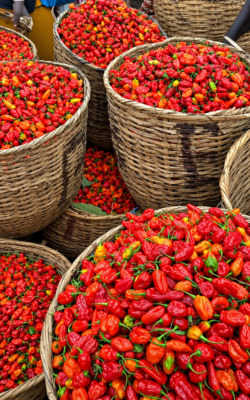
Pepper takes this week’s spotlight as the produce in high supply, with prices down in every zone against the 28 September – 3 October report. Prices now run from ₦15,000–18,000 in the North-West to ₦55,000–60,000 in the South-South, with the South-West at ₦30,000–40,000.
Plentiful supply pushes prices down, and Pepper carries a Moderate spoilage risk, so traders who rush to sell risk taking distress prices. Stock that is kept in good condition can be held until the price recovers. That is where ColdHubs cold storage helps traders protect their margins.
Our market outlook for the week.
Tomatoes: ↑ Increasing Price · Low Supply
Pepper: ↓ Decreasing Price · High Supply
Spring Onions: → Mixed Price · Low Supply
Green Beans: → Mixed Price · High Spoilage Risk
Carrots: ↓ Decreasing Price
Livestock (Cow): → Stable Price
HIGH-RISK PRODUCE THIS WEEK
Green Beans — HIGH RISK
Delicate pods, warm temperatures and delays in selling can quickly reduce quality.
When supply is high, cold storage protects your price.
This week’s Pepper glut shows why timing matters. When the market is flooded, prices fall and traders who must sell immediately take the loss.
With cold storage, you can:
- Hold stock until prices recover.
- Avoid selling at distress prices.
- Keep delicate produce like Green Beans sellable for longer.
The ColdHubs Market Report and Forecast brings together market observations, weather intelligence and cold-chain insights to help stakeholders better understand the fresh produce ecosystem.
Are you a farmer, trader, buyer or into food business? What are you seeing in your market this week?
Share your market observations with us.
ColdHubs Limited
KEEPING IT FRESH