
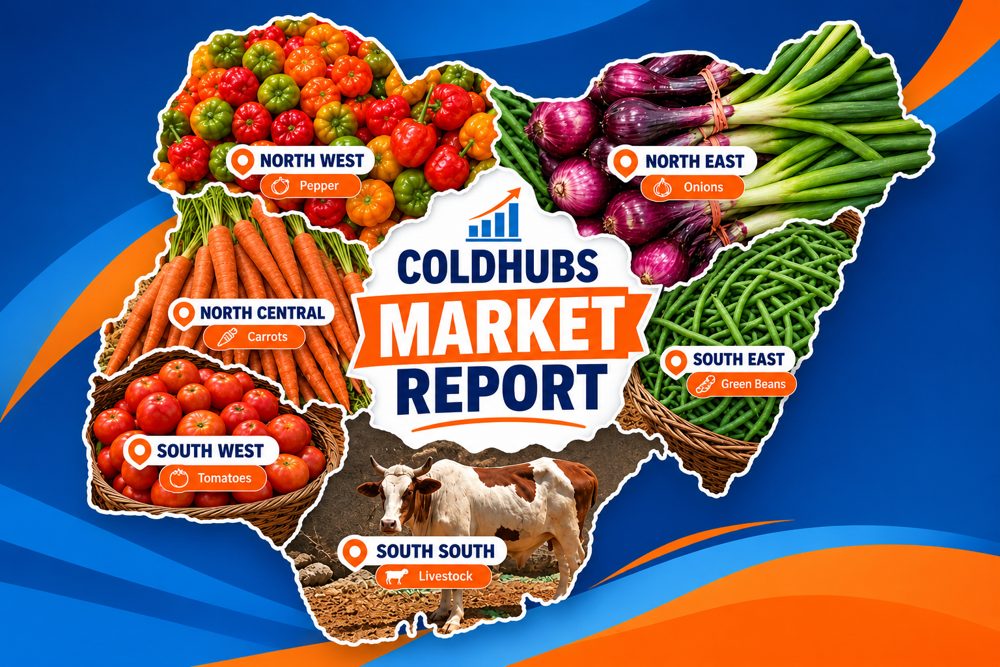
 28 SEPTEMBER – 3 OCTOBER 2026
Market Weekly
Weekly Market Report
Introduction
Market Weekly is ColdHubs’ weekly snapshot of fresh produce markets, bringing you key updates on prices, supply, demand, market conditions and emerging trends from markets across our network. Each edition combines on-the-ground market intelligence from ColdHubs Hub Managers and Operators with relevant weather insights to provide a practical outlook on what to expect in the week ahead.Market Weekly — Know the Market. Plan Better.
Prices from the biggest fresh produce market.
Significant Price Increase: Tomatoes
Tomatoes recorded the most significant price increase. North-Central rose from ₦10,000–12,000 to ₦15,000–18,000 (about 50%), South-West from ₦36,000–45,000 to ₦50,000–60,000 (about 36%) and North-West from ₦20,000–25,000 to ₦20,000–35,000 (about 22%). South-East held at ₦40,000–45,000, while South-South eased slightly to ₦40,000–45,000 from ₦45,000–50,000.
High Demand Fresh Produce
Rising prices for Tomatoes and Pepper point to firm demand. Pepper ranges from ₦40,000 in the North-West to ₦120,000–140,000 in the South-West, roughly a threefold gap between zones.
Regional Price Gaps: Carrots
Carrots show the widest spread. The North-West is lowest at ₦37,000–40,000, while the South-East, South-South and South-West sit at ₦100,000–110,000. North-Central has jumped to ₦55,000–65,000, up from ₦30,000–35,000 in the 31 August report.
Stable Band: Green Beans
Green Beans are tightly clustered at ₦40,000–45,000 across the North-West, South-East, South-South and South-West, with North-Central lower at ₦25,000–30,000.
Spring Onions
Spring Onions are the cheapest item in the North-West at ₦15,000–20,000, against ₦35,000 in North-Central and South-South and ₦25,000 in the South-East and South-West.
High Spoilage Risk Fresh Produce
Spring Onions remain the fresh produce at highest risk of spoilage. As a leafy, high-moisture vegetable, it loses quality quickly when sales are delayed.
28 September – 3 October 2026 · Six Geopolitical Zones in Nigeria
| S/N | Produce | N/Central | N/East | N/West | S/East | S/South | S/West |
|---|---|---|---|---|---|---|---|
| 1 | Tomatoes | ₦15,000-18,000 | – | ₦20,000-35,000 | ₦40,000-45,000 | ₦40,000-45,000 | ₦50,000-60,000 |
| 2 | Pepper | ₦26,000-30,000 | – | ₦40,000 | ₦70,000 | ₦80,000 | ₦120,000-140,000 |
| 3 | Carrots | ₦55,000-65,000 | – | ₦37,000-40,000 | ₦100,000 | ₦100,000-110,000 | ₦100,000-110,000 |
| 4 | Green Beans | ₦25,000-30,000 | – | ₦40,000-45,000 | ₦40,000-45,000 | ₦40,000-45,000 | ₦40,000-45,000 |
| 5 | Spring Onions | ₦35,000 | – | ₦15,000-20,000 | ₦25,000 | ₦35,000 | ₦25,000 |
Note: “-” indicates no price data recorded for that zone at this time. Quantities: Tomatoes 50kg, Pepper 25kg, Carrots 70kg, Green Beans 50kg, Spring Onions 70kg.
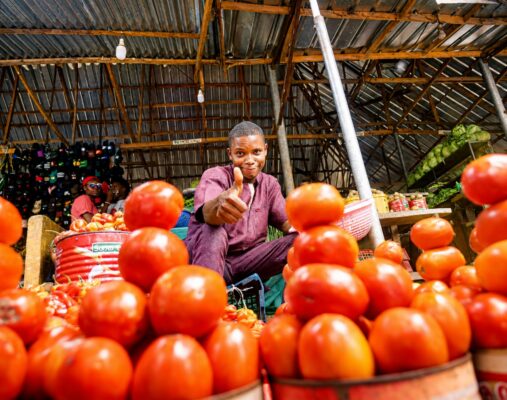
TOMATOES
Tomatoes take this week’s spotlight for the most significant price increase in the market. Prices now run from ₦15,000–18,000 in North-Central to ₦50,000–60,000 in the South-West, with the North-West at ₦20,000–35,000.
Higher prices make every crate count. Tomatoes carry a High spoilage risk, so stock that is kept in good condition can be sold when the price is right instead of being rushed to market. That is where ColdHubs cold storage helps traders protect their margins.Our market outlook for the week.
- Tomatoes: ↑ Increasing Price
- Pepper: ↑ Increasing Price
- Spring Onions: → Stable Price · High Spoilage Risk
- Green Beans: → Increasing Price · High Spoilage Risk
- Carrots: → Stable Price
- Livestock (Cow): → Stable Price
HIGH-RISK PRODUCE THIS WEEK
Spring Onions — VERY HIGH RISK
High moisture content, warm temperatures and delays in selling can quickly reduce quality.
Don’t wait until produce begins to spoil before thinking about preservation.
The economic value of cold storage is not simply about keeping food cold. It is about buying time.More time can mean:
- More selling options.
- Less pressure to accept distress prices.
- Less food waste.
Share your market observations with us.
ColdHubs Limited
KEEPING IT FRESH